
Phonics
How do we teach phonics?
The Rocket Phonics Systematic Synthetic Phonics Teaching Principles
The Systematic Synthetic Phonics Teaching Principles are the specific knowledge and skills children need to be able to read and write in the English language. These principles can be broken down into smaller steps.
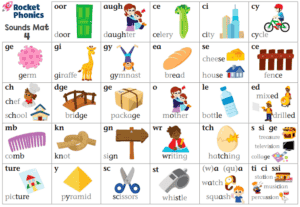
Knowledge of the English Alphabetic Code (150+ graphemes that represent 44 speech sounds)
- see the letters, say the sounds for reading to automaticity
- hear the sounds, recall the letters for spelling to automaticity (these are reversible processes)
Skill of blending for reading
- oral blending
- modelled blending
- supported blending
- independent blending at word, sentence and text levels
Skill of segmenting for spelling
- oral segmenting
- modelled segmenting
- supported segmenting
- knowing which spelling alternative to use
Skill of handwriting
- pencil hold
- letter formation
- positioning on a writing line
- print before cursive
Rocket Phonics lesson structure
Rocket Phonics teaches one letter-sound correspondence over two days. The first day focuses on blending skills and the second day focuses on segmenting skills. Reading and writing are interlinked so there will naturally be overlap, but by separating the skills and spreading them across two days the teacher has greater clarity over which skill is being taught, practised or applied. The children have more time and more opportunity to learn, practise and apply the skills using the new letter-sound correspondences before moving on.
The two-day pattern is repeated twice through the week, leaving the fifth day as an opportunity for further consolidation, assessment, enrichment activities or as a focus lesson on common exception words (for which lesson plans and Pupil Practice Booklet lessons are provided).
Day 1: Blending focus
Revisit and review – Use flashcards to revisit and review previously taught sounds.
Teach – Use the IWB Big Book to teach the new letter-sound correspondence.
Practise and apply – Children practise decoding using the Big Book decodable word lozenges, then using the first Pupil Practice Booklet lesson page.
Apply – Use Target Practice reading books for shared, guided and/or individual reading.
Further application and consolidation – Children read independently using Rocket Phonics reading books.
Day 2: Segmenting focus
Revisit and review – Use air writing to revisit and review previously taught sounds.
Teach – Use your flipchart or whiteboard to model and teach letter formation and segmenting.
Practise and apply – Children practise segmenting and letter formation using mini whiteboards, then using the second Pupil Practice Booklet lesson page.
Apply – Children transfer skills to English and wider curriculum lessons.
Day 3 and 4: Blending focus and segmenting focus
The above sequence in Days 1 and 2 is repeated with the new letter-sound correspondence.
Day 5: Flexible day
A flexible day that can be tailored to your children’s needs.
Consolidation − Revisit learning using flashcards, Big Book spreads and games.
Focus on common exception words − Use the Pupil Practice Booklet common exception word lesson to teach, practice, apply and consolidate (lesson plans provided for each week).
Assessment − Check, observe and make notes on children’s progress.
Enrichment − Play games such as letter-sound or word bingo or use activities. Use Target Practice reading books for whole class shared, or group guided reading sessions
In Year 1, once children have learnt a number of sounds and can put these together to read words, they need daily practice in reading. We use an approach called ‘scaffolded reading’. The teacher shows the children how to read at the right speed, use expression, and stop at the right places. They also model how to sound out words and put the sounds together. Children then read the text back to the teacher – this is called repeated reading. As the year progresses, children then begin to practise reading the text to partners while the teacher moves around the room ‘listening in’.
Once children have completed the phonics programme (usually during Year 2), they experience different types of reading lessons each aimed at developing fluent, confident readers:
- Fluency reading
- Extended reading
- Close reading

Rocket Phonics Redfield Edge Primary Skills Progression
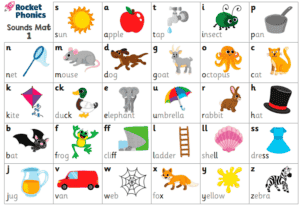
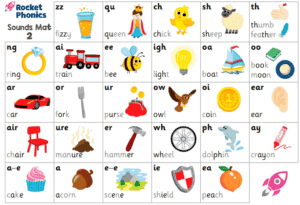
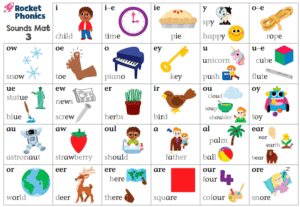

Phonics Frieze Set 1 Phonics Frieze Set 2